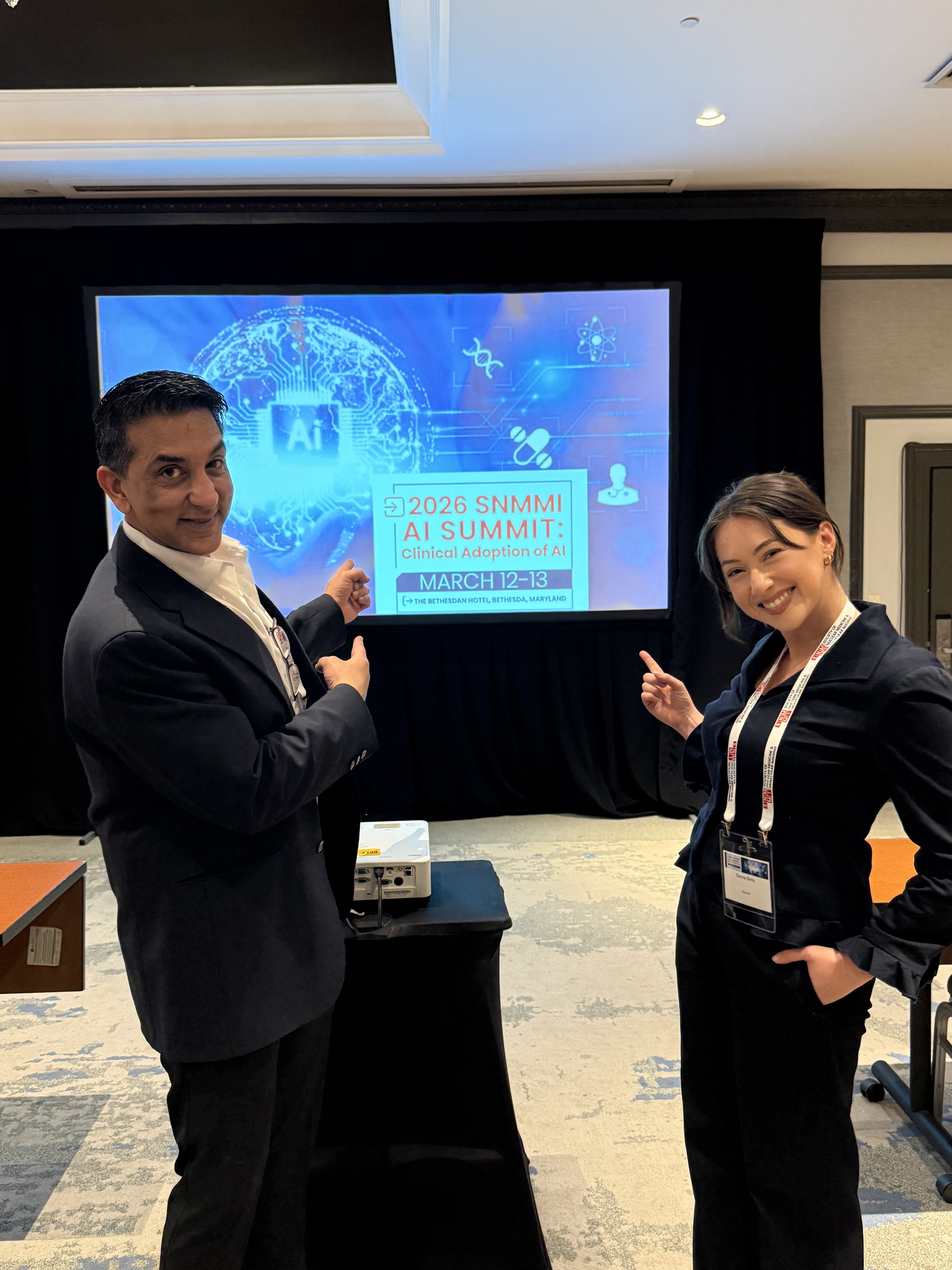
SNMMI AI Summit 2026
Nucs AI is a Gold Sponsor and sponsor of the "Economics of AI" panel, with live product demos at the Hands-On AI Showcase.


SNMMI AI Summit 2026: Key Takeaways from Baltimore
March12–13, 2026 | Baltimore, MD
The SNMMI AI Summit brought together clinicians,researchers, regulators, and industry leaders to explore the rapidly evolvingrole of artificial intelligence in nuclear medicine. As a sponsor of thisyear's summit, the Nucs AI team was on-site to engage with the community andstay at the forefront of the conversation shaping our field.
Regulatory Science Is Catching Up to Innovation
The FDA's Alda Badano opened the summit with a look at howregulatory frameworks are adapting to AI. A key theme: evaluation methodologiesneed to evolve alongside the technology. The FDA's Regulatory Science Tools(RST) Catalog is making open-source code, bench tests, and datasets availableto developers — a signal that the agency is actively working to accelerateresponsible AI adoption. High-quality synthetic data also emerged as asignificant topic, with growing evidence supporting its role in training andvalidation.
AI Is Moving Beyond Diagnostics
A recurring message across sessions: AI in nuclear medicineis no longer just about image segmentation or lesion detection. Speakersoutlined a broader vision — from quantitative PET biomarkers and predictivemodeling to patient-specific dosimetry and AI-guided drug discovery. Dr.Hongyoon Choi framed the shift as a move from task-specific tools to agentic,workflow-level AI that can orchestrate entire clinical processes. The futurepoints toward digital twins and patient-specific simulations that could transformtheranostic treatment planning.
Computational Nuclear Oncology Takes Center Stage
Dr. Pedram Heidari delivered a comprehensive overview ofAI's expanding role across the nuclear oncology pipeline — spanningultra-low-dose PET imaging, automated tumor segmentation, radiomics, multimodaldata integration, and operational workflow optimization. The throughline: AI isenabling a level of quantitative precision that manual approaches simply cannotachieve at scale, with the physician remaining firmly in the loop.
Building the Data Infrastructure for Clinical Translation
The summit's final sessions tackled one of the field's mostpressing challenges: how to build sustainable data ecosystems that supportclinical validation and real-world AI translation. Panels explored theeconomics of AI adoption, models for industry-academia partnerships, and thepractical question of convincing nuclear medicine physicians to adoptquantitative AI reporting in routine practice. The consensus: make the toolswidely available, then demonstrate their clinical value through rigorous studies.
Looking Ahead
The SNMMI AI Summit reinforced that AI in nuclear medicineis moving from promise to practice — but the path requires collaboration acrossclinical, technical, and regulatory domains. For Nucs AI, these conversationsdirectly align with our mission to bring clinically validated,physician-centered AI tools to nuclear medicine and radiology.
We're looking forward to continuing the conversation at PSMA& Beyond (March 26–27, Los Angeles) and the SNMMI Annual Meeting (May 30 –June 2, Los Angeles).